

LA DICHIARAZIONE DI CONFORMITA’ DI UN IMPIANTO
The declaration of conformity of an installation
- 02 Giu 2025
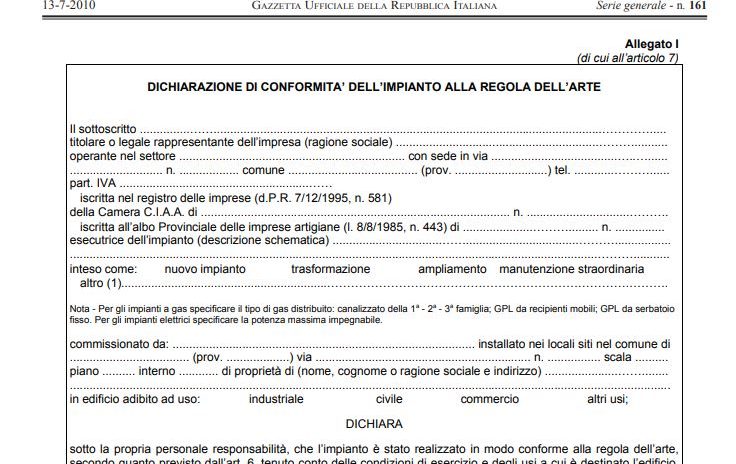
La dichiarazione di conformità è un documento con cui un impiantista certifica di aver realizzato “a regola d’arte” l’impianto che gli è stato commissionato.
Cosa si intende per regola d’arte? Per trovare la corretta definizione di “regola d’arte” dobbiamo richiamare la legge 186/68 che recita testualmente “le installazioni e gli impianti elettrici ed elettronici realizzati secondo le norme del Comitato Elettrotecnico Italiano (CEI) si considerano costruiti a regola d’arte”. Definizione analoga si ritrova all’articolo 6 del DM 37/08 “Gli impianti realizzati in conformità alla vigente normativa e alle norme dell’UNI, del CEI o di altri Enti di normalizzazione appartenenti agli Stati membri dell’Unione europea o che sono parti contraenti dell’accordo sullo spazio economico europeo, si considerano eseguiti secondo la regola dell’arte.”
L’obbligo di redigere la dichiarazione di conformità deriva dall’articolo 7 comma 1 del DM 37/08 che recita “Al termine dei lavori, previa effettuazione delle verifiche previste dalla normativa vigente, comprese quelle di funzionalità dell’impianto, l’impresa installatrice rilascia al committente la dichiarazione di conformità degli impianti realizzati … omissis …”
I contenuti della dichiarazione sono definiti in modo specifico dalla Norma ed in particolare indicati nel modello tipo presente nel “Decreto Ministeriale 19 maggio 2010 “Modifica degli allegati al decreto 22 gennaio 2008, n. 37, concernente il regolamento in materia di attività di installazione degli impianti all’interno degli edifici”.
Tali contenuti devono intendersi da rispettarsi in modo obbligatorio, pena inficiare la dichiarazione in questione.
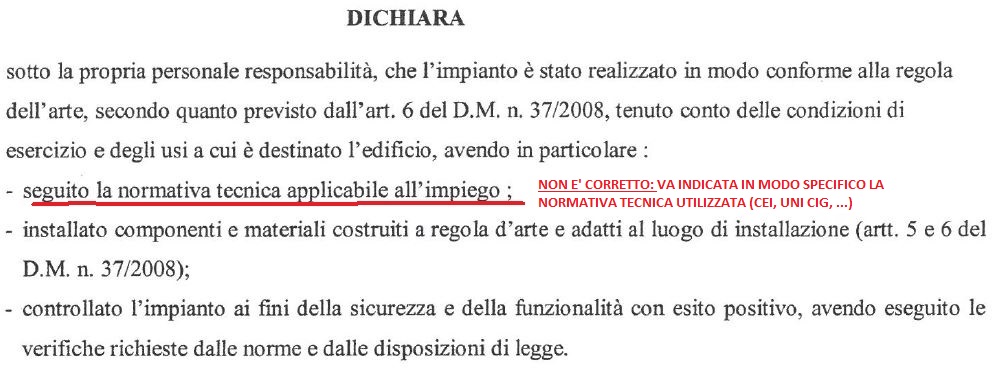
Ad esempio indicazioni generiche sulla Normativa Tecnica utilizzata non sono sufficienti:
L’importanza di Dichiarazioni di Conformità degli impianti che siano valide nella sostanza ed anche nella forma è ulteriormente diventata di attualità in conseguenza delle richieste di smart working dalle proprie case connessa all’epidemia di COVID-19. Le abitazioni diventano, di fatto, luoghi di lavori e che devono pertanto rispettare, pena il loro non riconoscimento come tali (anche in relazione a problematiche asscurative INAIL), i corretti parametri di Sicurezza sul lavoro
 Ing. Fabio Di Matteo – ZED PROGETTI srl
The declaration of conformity is a document in which an installer certifies that he has carried out the commissioned installation ‘in a workmanlike manner’.
What is meant by ‘state of the art’? To find the correct definition of “state of the art”, we must refer to Law 186/68, which states that “electrical and electronic installations and systems built according to the standards of the Italian Electrotechnical Committee (CEI) are considered to be built in a workmanlike manner”. A similar definition can be found in Article 6 of Ministerial Decree 37/08: “Installations made in compliance with current legislation and with the standards of UNI, CEI or other standardisation bodies belonging to Member States of the European Union or which are contracting parties to the Agreement on the European Economic Area, are considered to have been made in accordance with the rules of art.
The obligation to draw up the declaration of conformity derives from article 7, paragraph 1 of Ministerial Decree 37/08 which states: “At the end of the works, after carrying out the verifications foreseen by the regulations in force, including those of functionality of the system, the installation company issues to the client the declaration of conformity of the systems carried out … omissis …”.The contents of the declaration are specifically defined by the Standard and in particular indicated in the standard model included in the “Ministerial Decree 19 May 2010 “Modification of the annexes to Decree 22 January 2008, no. 37, concerning the regulation on the installation of systems inside buildings”.
These contents must be compulsorily respected, otherwise the declaration in question will be invalidated.
The importance of declarations of conformity for installations that are valid both in substance and in form has become even more topical as a result of the demand for smart working from home in connection with the COVID-19 epidemic. Homes become de facto workplaces and must therefore comply with the correct work safety parameters, otherwise they will not be recognised as such (also in relation to INAIL insurance issues).